

What makes Transformer a foundation for generalized, scalable robot intelligence?
The core mechanism uniquely capable of learning relevant information

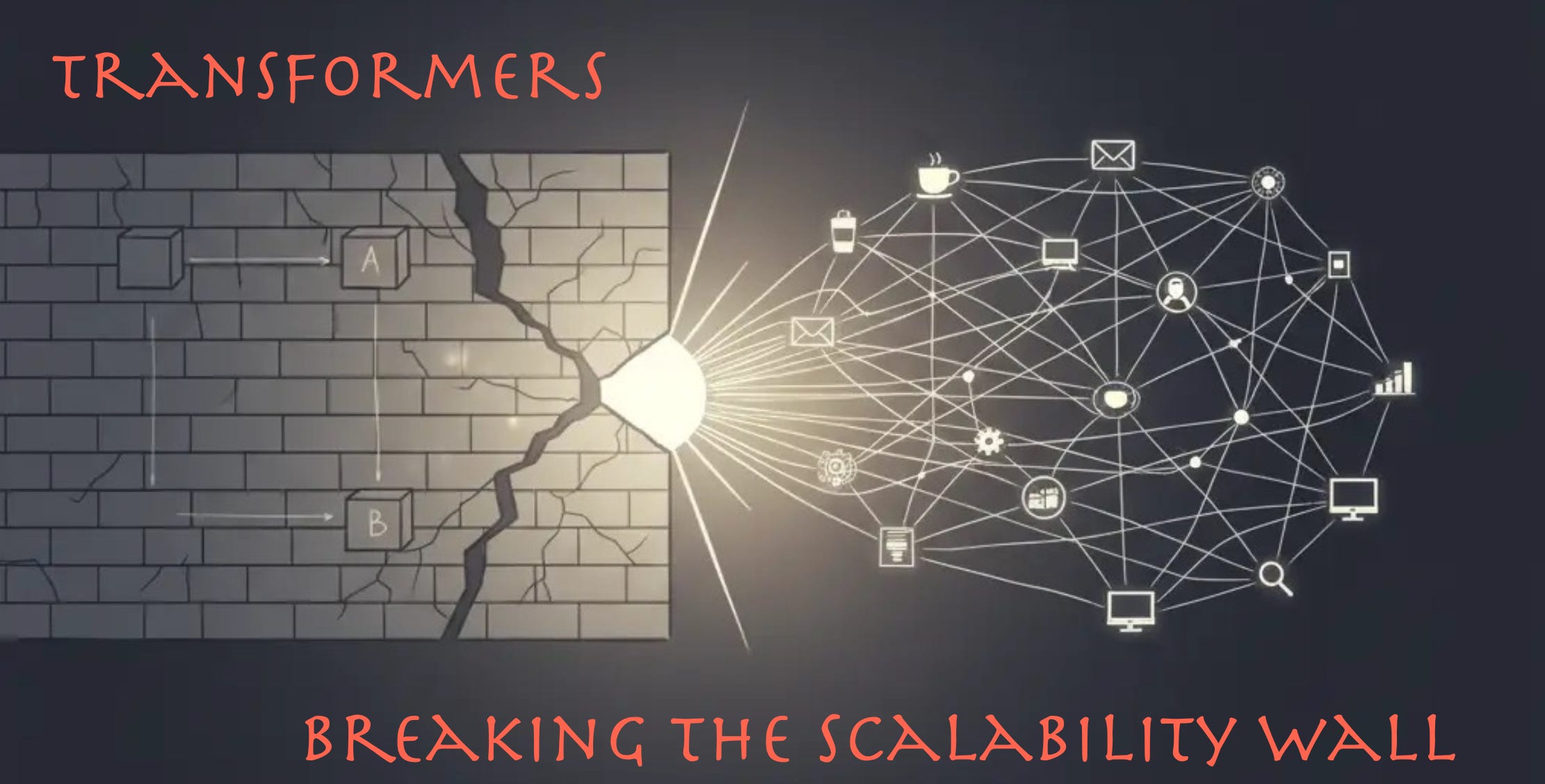
There’s a wall you will hit in robotics that has nothing to do with your code working. It’s the Scalability Wall.
Your robot can flawlessly sort blue blocks from red blocks. But the moment you want it to learn a new task—like sorting mail or making coffee—you are starting from scratch. The massive investment of time and compute you poured into Task A doesn’t transfer to Task B. This lack of generalization is why truly autonomous, multi-purpose robots have remained in science fiction.
The goal isn’t just functional code. It’s transferable intelligence.
The breakthrough isn’t another clever programming trick. It’s an architectural revolution in AI: the Transformer. This single idea powers the most promising generalist robot models today, like RT-2 and VLM-based systems. It doesn’t solve every problem at once. Instead, it provides a universal framework for knowledge acquisition.
So, what is the Transformer, and what makes its core mechanism so uniquely capable of creating a foundation for generalized, scalable robot intelligence?
The answer lies in one superpower: Self-Attention.
The Problem Your Robot Can’t See
To appreciate the Transformer, we must first look at what came before.
Think of the old way—used by AI models like RNNs—as an assembly line. The system was forced to process information sequentially, one word or one sensor reading at a time.
Imagine your robot reading the instruction: “Grasp the large yellow box on the table, and put it on the shelf.”
The old AI was like a train car, carrying the information from “Grasp” all the way to “it.” By the time it arrived at “it,” the details of the “large yellow box” from many words back were often forgotten or muddled. This sequential processing was a computational game of telephone. It made retaining long-range context nearly impossible.
Your robot was effectively blind to the full picture.
The Super-Sleuth Spotlight: Self-Attention
The Transformer shattered this limitation with a mechanism called Self-Attention. It processes the entire input—every word, every pixel, every sensor reading—all at once.
Forget the train. Imagine instead a team of super-sleuths analyzing the entire instruction simultaneously.
When one sleuth focuses on the word “it,” they don’t wait. They immediately shine a spotlight on every other word in the sentence. They assign an importance score to each one based on its relevance to “it.”
The word “box” gets a very high score. “Table” gets a medium score. “Grasp” gets a lower one.
This is the secret sauce. It creates what we call the Context Mix.
To a robot, the meaning of a word or a pixel is a list of numbers called a Vector. Think of it as a GPS coordinate on a map of concepts.
The Context Mix is a weighted sum that works like this:
New Meaning of “it” = (Meaning of “box” × High Score) + (Meaning of “table” × Medium Score) + …
The result is a new, enriched coordinate for “it” that inherently includes the relevant details of the “large yellow box.” By shining that spotlight and mixing the context simultaneously, the Transformer never loses track of the most important relationships.
It sees the entire forest and every single tree, all at the same time.
From Text to Robots: The Real-World Payoff
This ability to look at all data at once was the spark that ignited a revolution. Its effects cascade directly into the robots you want to build.
The first-order effect was pure speed. By switching from sequential to parallel processing, the Transformer unlocked the massive power of modern GPUs and TPUs.
The builder takeaway is scale. This speed meant models could be trained on vastly larger datasets—the entire internet. They scaled into Large Language Models (LLMs) with billions of parameters. This scale is what created genuine, generalized intelligence, not just simple pattern matching.
The second-order effect is universal perception. The genius of the Transformer is that it works on any sequence of data.
It instantly revolutionized computer vision. Models called Vision Transformers (ViTs) treat image patches like words, allowing a robot to use self-attention to understand the relationship between distant parts of a scene, like the object it needs and the gripper it controls.
This leads to a seamless nervous system. The Transformer uses Cross-Attention to fuse different data streams—a text instruction, a camera image, and a tactile sensor reading—into one coherent understanding. It’s the AI equivalent of your own nervous system combining sight and touch to perform a delicate grasp.
This is the foundation of Vision-Language-Action models that power the newest generation of generalist robots.
Get Ready to Build the Future
The simplicity of self-attention—the ability to consider all context at once—is the single idea that fundamentally changed the game. It gave us the speed to build colossal models and the architectural flexibility to create a unified, multi-modal brain.
For us in robotics, this is a pivotal shift. The AI controlling your hardware is no longer a collection of brittle, single-task systems. It is a generalist brain capable of true high-level reasoning.
The Transformer is the engine that allows your robot to not just execute code, but to understand natural language, plan complex actions, and feel the world through its sensors.
Get ready to build robots you can talk to.
The most exciting projects of the next decade will be built not with clever programming tricks, but by leveraging the transferable intelligence unlocked by the Transformer.
Happy building!
If this glimpse into the future of robotics excites you, subscribe to BuildRobotz. I send insights like this directly to your inbox every week.
And if you’re ready to start your own journey in robotics, just hit reply. Tell me what you’re thinking about building, and I can help you figure out your first step.
PS. Seriously, reply to this email. I love hearing about your projects and I’m always happy to offer some guidance.
Brilliant breakdown of self-attention! The parallel processing shift is the real game changer here. What's often underestimated is how the Context Mix mechanisn lets different attention heads specialize, creating this emergent hierachy where some focus on local spatial relationships while others capture global scene semantics.